
If you are searching for Loss Mitigation NYC, you are likely facing financial challenges that have made it difficult to keep up with your mortgage payments. Whether the hardship was caused by job loss, rising living expenses, unexpected medical bills, divorce, or another life event, it is important to understand that foreclosure is not your only option.
Many homeowners in New York City assume that once they miss a few mortgage payments, losing their home is inevitable. In reality, lenders often offer several Loss Mitigation NYC solutions that are designed to help qualified homeowners avoid foreclosure and regain financial stability. These options are intended to reduce losses for both the homeowner and the lender while creating a path toward a more manageable financial future.
Taking action early is one of the most important steps you can take. The sooner you communicate with your mortgage servicer and understand your available options, the greater the likelihood of finding a solution that fits your circumstances.
What Is Loss Mitigation NYC?
Loss Mitigation NYC refers to the process lenders use to help homeowners who are struggling to make mortgage payments avoid foreclosure. Instead of immediately pursuing foreclosure, many mortgage servicers review a homeowner’s financial situation to determine whether an alternative solution may be available.
Loss mitigation is not a single program. Rather, it is a collection of options that may help homeowners resolve mortgage delinquency while minimizing financial losses.
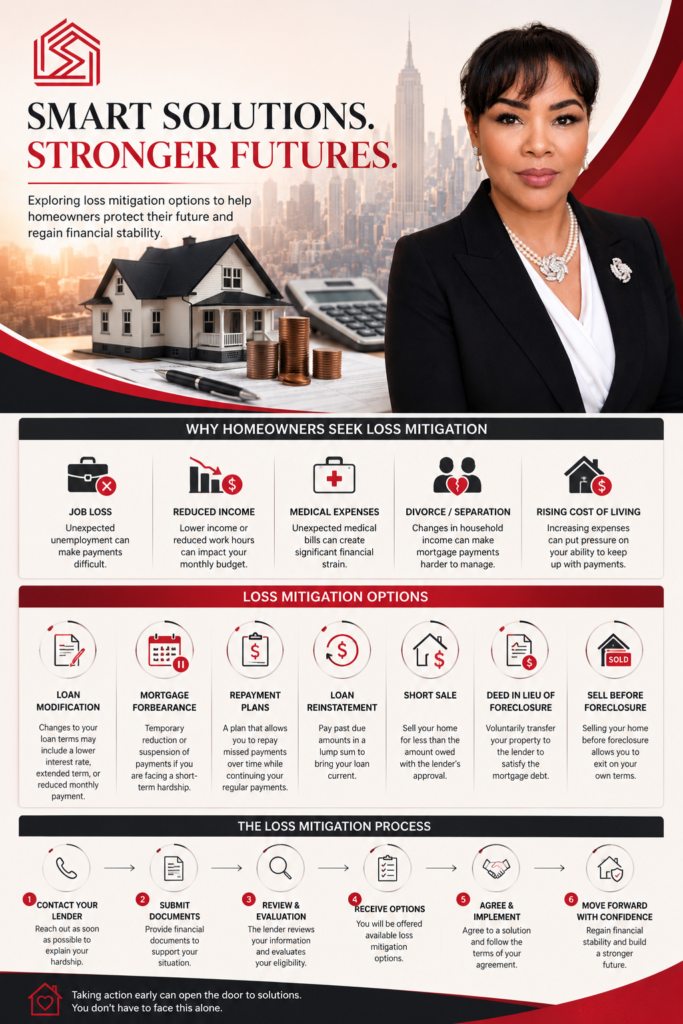
Depending on your lender and your financial circumstances, loss mitigation may include:
- Loan Modification
- Mortgage Forbearance
- Repayment Plans
- Loan Reinstatement
- Short Sale
- Deed in Lieu of Foreclosure
- Selling the Property Before Foreclosure
Each option has different eligibility requirements, benefits, and potential financial consequences.
Why Is Loss Mitigation Important?
The primary purpose of Loss Mitigation NYC is to provide homeowners with alternatives before foreclosure becomes the final outcome.
Foreclosure can have long-lasting financial consequences, including damage to credit history, loss of home equity, and difficulty obtaining future financing. Loss mitigation gives homeowners an opportunity to explore solutions that may help them remain in their home or exit the property in a more controlled manner.
For lenders, loss mitigation often reduces the costs associated with lengthy foreclosure proceedings and property management.
Common Reasons Homeowners Seek Loss Mitigation NYC
Financial hardship can affect homeowners from all walks of life. Some of the most common reasons people seek Loss Mitigation NYC include:
Job Loss
Unexpected unemployment is one of the leading causes of missed mortgage payments. Even a temporary loss of income can quickly make monthly obligations difficult to manage.
Reduced Household Income
Reduced work hours, salary reductions, or declining business revenue may significantly impact a homeowner’s ability to stay current on mortgage payments.
Medical Expenses
Unexpected medical emergencies can create substantial financial pressure, forcing families to prioritize healthcare costs over mortgage obligations.
Divorce or Separation
Changes in household income following a divorce or separation often make existing mortgage payments less affordable.
Rising Cost of Living
Increasing property taxes, homeowners insurance premiums, utility costs, and everyday expenses continue to place financial strain on many New York City homeowners.
Types of Loss Mitigation Options Available
Understanding the available solutions is an important part of exploring Loss Mitigation NYC.
Loan Modification
Loan modification permanently changes one or more terms of your existing mortgage.
Possible changes may include:
- Lower interest rate
- Extended repayment period
- Reduced monthly mortgage payment
- Capitalization of missed payments into the remaining loan balance
Loan modification is generally considered for homeowners experiencing long-term financial hardship.
Mortgage Forbearance
Mortgage forbearance temporarily reduces or suspends mortgage payments for homeowners facing temporary financial hardship.
This option may be appropriate for homeowners who expect their financial situation to improve after a short period.
Once the forbearance period ends, repayment arrangements are made according to the agreement with the lender.
Repayment Plans
A repayment plan allows homeowners to gradually repay missed mortgage payments while continuing regular monthly payments.
This solution is often used when a homeowner has recovered financially and can resume making mortgage payments but needs additional time to catch up on overdue amounts.
Loan Reinstatement
Loan reinstatement requires the homeowner to pay all overdue mortgage payments, interest, and applicable fees in a lump sum to bring the loan current.
Once the lender accepts the reinstatement payment, the mortgage returns to its original payment schedule.
Short Sale
If the property’s market value is lower than the remaining mortgage balance, a lender-approved short sale may allow the homeowner to sell the property before foreclosure is completed.
Although a short sale does not allow the homeowner to keep the property, it may reduce the long-term financial impact compared to foreclosure.
Deed in Lieu of Foreclosure
A deed in lieu of foreclosure allows a homeowner to voluntarily transfer ownership of the property to the lender to satisfy the mortgage debt.
This option is generally considered only after other loss mitigation alternatives have been explored.
How Does the Loss Mitigation Process Work?
The Loss Mitigation NYC process usually begins when a homeowner contacts the mortgage servicer to explain their financial hardship.
The lender may request documentation such as:
- Recent pay stubs
- Tax returns
- Bank statements
- Mortgage statements
- Monthly household budget
- Hardship letter
- Proof of income
- Employment information
After reviewing the documentation, the lender determines whether the homeowner qualifies for one or more available loss mitigation options.
Every lender follows its own review process, and approval depends on the homeowner’s individual circumstances.
Can Loss Mitigation Stop Foreclosure?
In many situations, Loss Mitigation NYC may delay or prevent foreclosure while the lender reviews a homeowner’s application.
Submitting a complete application and responding promptly to requests for additional documentation can help avoid unnecessary delays.
Although approval is never guaranteed, homeowners who begin the process early generally have more options available than those who wait until foreclosure proceedings are nearly complete.
Benefits of Loss Mitigation NYC
Exploring Loss Mitigation NYC options early may provide homeowners with more flexibility when dealing with financial hardship. While every situation is different and eligibility depends on lender requirements, many homeowners find that loss mitigation offers alternatives that may help them avoid foreclosure or reduce its financial impact.
Opportunity to Avoid Foreclosure
One of the primary goals of Loss Mitigation NYC is to provide homeowners with alternatives before foreclosure becomes the final outcome. Depending on the option selected, homeowners may be able to remain in their home or transition out of the property in a more controlled manner.
More Affordable Mortgage Payments
Solutions such as loan modification may reduce monthly mortgage payments by adjusting the loan terms. For homeowners experiencing long-term financial hardship, this may make homeownership more sustainable.
Protection of Home Equity
Selling a property before foreclosure or pursuing another loss mitigation option may help preserve available equity that could otherwise be lost during foreclosure proceedings.
Reduced Financial Stress
Financial uncertainty can affect every aspect of daily life. Understanding available options and communicating with your lender early often provides greater clarity and helps homeowners make informed decisions.
More Time to Evaluate Options
Beginning the Loss Mitigation NYC process early often gives homeowners additional time to gather documentation, review available alternatives, and determine the best path forward.
Common Mistakes Homeowners Make
Many homeowners unintentionally limit their options by waiting too long or misunderstanding the foreclosure process. Avoiding these common mistakes may improve your chances of finding an appropriate solution.
Ignoring Mortgage Servicer Communications
Letters and notices from your lender often contain important deadlines and information about available assistance programs. Ignoring these communications can make resolving the situation more difficult.
Waiting Until Foreclosure Is Imminent
Many homeowners delay seeking help because they hope their financial situation will improve on its own. Unfortunately, waiting may reduce the number of available loss mitigation options.
Submitting Incomplete Documentation
Lenders generally require detailed financial information before reviewing a loss mitigation application. Missing or inaccurate documents may delay the review process.
Assuming There Is Only One Solution
Loan modification is only one of several available options. Depending on your circumstances, repayment plans, forbearance, reinstatement, a short sale, or another solution may be more appropriate.
Why Acting Early Matters
Timing plays a significant role in the success of any Loss Mitigation NYC strategy.
New York follows a judicial foreclosure process, meaning lenders generally must complete court proceedings before a foreclosure sale can occur. Although this process may provide homeowners with additional time, it should not be viewed as a reason to delay action.
The earlier homeowners begin exploring loss mitigation options, the greater the opportunity to communicate with the lender, prepare required documentation, and review potential solutions before legal deadlines become more restrictive.
How Samantha Stone Helps Homeowners Explore Their Options
Every homeowner’s financial situation is unique. Understanding lender requirements, evaluating foreclosure alternatives, and navigating the loss mitigation process can feel overwhelming without the right guidance.
Samantha Stone works with homeowners throughout New York City to help them understand available foreclosure alternatives and make informed decisions based on their individual circumstances. Whether you are exploring a loan modification, repayment plan, short sale, or another loss mitigation option, having experienced guidance can help you better understand the process.
Need Help Exploring Loss Mitigation NYC?
If you’re experiencing financial hardship, taking action early may give you more options before foreclosure progresses. Understanding the available Loss Mitigation NYC solutions can help you make informed decisions about your home and financial future.
Contact Samantha Stone
📞 Call or Text: 718-916-5974
📧 Email: samanthastone5910@gmail.com
🌐 Secure Portal: https://samanthastone.online/stop-foreclosure
Whether you’re looking to understand your options or explore possible foreclosure alternatives, reaching out early can help you evaluate the solutions that may be available for your situation.
Frequently Asked Questions
What is Loss Mitigation NYC?
Loss Mitigation NYC refers to a range of options offered by mortgage lenders to help homeowners experiencing financial hardship avoid foreclosure. These options may include loan modification, mortgage forbearance, repayment plans, short sales, and deed in lieu of foreclosure.
Can loss mitigation stop foreclosure?
Depending on your circumstances and the stage of the foreclosure process, submitting a complete loss mitigation application may delay foreclosure while the lender reviews your eligibility. Approval is subject to lender requirements.
Who qualifies for Loss Mitigation NYC?
Eligibility depends on several factors, including your financial hardship, income, mortgage type, payment history, and the specific guidelines established by your mortgage servicer.
Is loan modification the same as loss mitigation?
No. Loan modification is one possible outcome of the Loss Mitigation NYC process. Loss mitigation is a broader term that includes several foreclosure alternatives.
What documents are needed for loss mitigation?
Lenders commonly request recent pay stubs, tax returns, bank statements, mortgage statements, a hardship letter, proof of income, and information about monthly household expenses.
Does applying for loss mitigation guarantee approval?
No. Every application is reviewed individually. Approval depends on your financial circumstances, lender policies, and the completeness of your application.
Can I sell my house during loss mitigation?
In some situations, homeowners may sell their property before foreclosure is completed. Depending on the amount owed and the property’s value, a traditional sale or a short sale may be considered.
When should I apply for loss mitigation?
Homeowners should begin exploring Loss Mitigation NYC options as soon as financial hardship affects their ability to make mortgage payments. Early action generally provides more flexibility and more available solutions.
Related Articles
Continue learning about foreclosure alternatives by reading these related resources:
- Loan Modification NYC
- Mortgage Assistance NYC
- Mortgage Relief NYC
- Stop Foreclosure NYC
- Mortgage Forbearance
- Mortgage Default
- Mortgage Delinquency
- Foreclosure Prevention
- Foreclosure vs Short Sale
- Can I Sell My House Before Foreclosure?
Helpful Resources
For additional educational information, homeowners may find these organizations useful:
- Consumer Financial Protection Bureau (CFPB)
- U.S. Department of Housing and Urban Development (HUD)
- New York State Unified Court System Foreclosure Resources
Conclusion
Facing mortgage difficulties can be overwhelming, but foreclosure is not always the only path forward. Loss Mitigation NYC offers a variety of potential solutions that may help eligible homeowners manage financial hardship, protect their investment, and explore alternatives before foreclosure is completed. By understanding your options, communicating with your lender early, and preparing the necessary documentation, you can make informed decisions based on your individual circumstances.