
If you are searching for Mortgage Forbearance NYC, you may be facing financial challenges that have made it difficult to keep up with your monthly mortgage payments. Whether your hardship is caused by job loss, reduced income, medical expenses, divorce, or another unexpected life event, falling behind on your mortgage does not automatically mean foreclosure is unavoidable.
Many homeowners throughout New York City experience temporary financial setbacks. Mortgage forbearance is one option that may provide short-term relief while you work toward financial recovery. Although it is not a permanent solution, it can create valuable time to stabilize your finances and evaluate long-term alternatives.
Understanding how Mortgage Forbearance NYC works, who may qualify, and what happens after the forbearance period ends can help you make informed decisions before your situation becomes more serious.
What Is Mortgage Forbearance NYC?
Mortgage Forbearance NYC is a temporary agreement between a homeowner and a mortgage servicer that allows mortgage payments to be reduced or suspended for a limited period due to financial hardship.
Unlike loan forgiveness, mortgage forbearance does not eliminate the amount you owe. Instead, it temporarily pauses or reduces payments while providing homeowners with an opportunity to recover financially. At the end of the forbearance period, the missed payments must generally be repaid according to the agreement established by the lender.
Mortgage forbearance is often considered one component of a broader loss mitigation strategy designed to help homeowners avoid foreclosure.
Why Homeowners Request Mortgage Forbearance NYC
Homeowners seek Mortgage Forbearance NYC for many different reasons. Financial hardship can occur unexpectedly, even for borrowers with a strong payment history.
Some of the most common situations include:
Job Loss
Losing employment or experiencing reduced work hours can quickly affect a homeowner’s ability to meet monthly mortgage obligations.
Medical Emergencies
Unexpected medical expenses may create significant financial pressure, making it difficult to prioritize mortgage payments.
Divorce or Separation
A change in household income following a divorce or separation can reduce the ability to maintain existing mortgage payments.
Business or Income Reduction
Self-employed homeowners and business owners may experience seasonal or unexpected declines in income that affect cash flow.
Unexpected Financial Hardship
Major home repairs, family emergencies, or other unforeseen events may temporarily impact a homeowner’s financial stability.
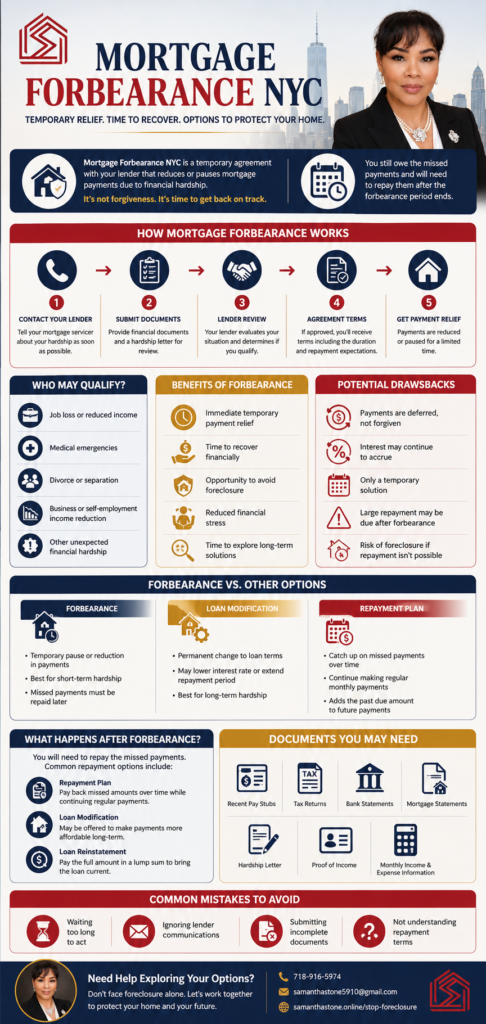
How Does Mortgage Forbearance Work?
The Mortgage Forbearance NYC process generally begins when a homeowner contacts their mortgage servicer to explain their financial hardship.
The lender may request supporting documentation such as:
- Recent pay stubs
- Tax returns
- Bank statements
- Mortgage statements
- Hardship letter
- Monthly income and expenses
- Proof of employment or unemployment
After reviewing the information, the lender determines whether the homeowner qualifies for a temporary forbearance agreement.
If approved, the agreement outlines:
- The length of the forbearance period
- Reduced or suspended payment terms
- Required homeowner responsibilities
- Repayment expectations after the agreement ends
Every lender establishes its own requirements and review process.
How Long Does Mortgage Forbearance Last?
The length of a Mortgage Forbearance NYC agreement varies depending on the lender, loan type, and the homeowner’s financial circumstances.
Some agreements last only a few months, while others may extend longer when additional hardship documentation is provided. Homeowners should carefully review the terms of any agreement and communicate with their lender if their financial situation changes.
What Happens After Mortgage Forbearance Ends?
One of the most common misunderstandings about Mortgage Forbearance NYC is that missed mortgage payments disappear after the forbearance period.
In reality, homeowners are generally responsible for repaying the postponed payments. Depending on the agreement, repayment may occur in several ways.
Repayment Plan
The homeowner gradually repays missed payments over time while continuing regular monthly mortgage payments.
Loan Modification
Some homeowners may qualify for a loan modification that permanently changes certain terms of the mortgage to create more affordable monthly payments.
Loan Reinstatement
If financially possible, homeowners may repay the outstanding balance in a lump sum and return the mortgage to current status.
The available repayment options depend on the lender’s policies and the homeowner’s financial circumstances.
Benefits of Mortgage Forbearance NYC
Exploring Mortgage Forbearance NYC may offer several advantages for homeowners experiencing temporary financial hardship.
Immediate Payment Relief
Mortgage forbearance can temporarily reduce or pause monthly mortgage payments, providing short-term financial flexibility.
Time to Recover Financially
Homeowners may use the forbearance period to secure new employment, recover from a medical emergency, or stabilize household finances.
Opportunity to Avoid Foreclosure
Forbearance may provide additional time to explore long-term foreclosure alternatives before legal proceedings advance.
Reduced Financial Pressure
Knowing that temporary payment relief is available can help reduce stress while homeowners evaluate their next steps.
Potential Drawbacks of Mortgage Forbearance NYC
While Mortgage Forbearance NYC can provide temporary financial relief, it is important to understand that it is not a permanent solution. Homeowners should carefully review the terms of any agreement before accepting it.
Payments Are Deferred, Not Forgiven
One of the biggest misconceptions about Mortgage Forbearance NYC is that missed mortgage payments are forgiven. In most cases, the payments are postponed and must be repaid later according to the agreement with the mortgage servicer.
Interest May Continue to Accrue
Depending on the loan terms, interest may continue to accrue during the forbearance period. Homeowners should review their mortgage agreement and discuss repayment expectations with their lender.
Temporary Solution
Mortgage forbearance is designed for homeowners experiencing short-term financial hardship. If your financial challenges are expected to continue for an extended period, another option such as a loan modification may be more appropriate.
Mortgage Forbearance NYC vs. Loan Modification
Although both options are designed to help homeowners avoid foreclosure, they serve different purposes.
Mortgage Forbearance
Mortgage forbearance temporarily reduces or pauses mortgage payments while the homeowner recovers financially. Once the forbearance period ends, repayment arrangements are made based on the lender’s guidelines.
This option is generally best suited for homeowners who expect their financial hardship to be temporary.
Loan Modification
A loan modification permanently changes one or more terms of the mortgage loan to create a more affordable monthly payment. Modifications may include lowering the interest rate, extending the repayment period, or restructuring the loan balance.
Homeowners experiencing long-term financial hardship may find a loan modification to be a more sustainable solution than temporary forbearance.
Mortgage Forbearance NYC vs. Repayment Plans
Another common foreclosure prevention option is a repayment plan.
With a repayment plan, homeowners continue making their regular monthly mortgage payments while gradually paying back missed payments over an agreed period.
Unlike mortgage forbearance, repayment plans do not pause future mortgage payments. Instead, they spread the overdue amount over several months, allowing homeowners to catch up while remaining current going forward.
The most appropriate option depends on the homeowner’s income, financial stability, and lender requirements.
Common Mistakes to Avoid
When considering Mortgage Forbearance NYC, avoiding common mistakes can improve your chances of achieving a positive outcome.
Waiting Too Long
Many homeowners delay contacting their mortgage servicer because they hope their financial situation will improve on its own. Acting early generally provides more flexibility and more available options.
Ignoring Lender Communications
Letters, emails, and phone calls from your mortgage servicer often contain important information about available assistance programs and required documentation.
Failing to Understand Repayment Terms
Before accepting a forbearance agreement, homeowners should understand how postponed payments will be repaid once the agreement ends.
Submitting Incomplete Documents
Providing complete and accurate financial information helps lenders review applications more efficiently and reduces unnecessary delays.
Alternatives to Mortgage Forbearance NYC
Mortgage forbearance is only one of several foreclosure prevention options. Depending on your financial circumstances, other alternatives may be more suitable.
These include:
- Loan Modification
- Repayment Plans
- Loan Reinstatement
- Short Sale
- Deed in Lieu of Foreclosure
- Selling the Property Before Foreclosure
Each solution has different requirements, benefits, and long-term financial implications. Understanding all available options can help homeowners choose the path that best aligns with their goals.
How Samantha Stone Helps Homeowners Explore Their Options
Every homeowner’s financial situation is different, and there is no one-size-fits-all solution. Understanding mortgage forbearance, lender requirements, and foreclosure alternatives can feel overwhelming during an already stressful time.
Samantha Stone works with homeowners throughout New York City to help them understand available options, evaluate foreclosure alternatives, and make informed decisions based on their individual circumstances. Whether you are considering Mortgage Forbearance NYC, a loan modification, or another loss mitigation strategy, professional guidance can help you better understand the process.
Need Help Exploring Mortgage Forbearance NYC?
If you’re experiencing financial hardship, acting early may provide more opportunities to protect your home and evaluate available foreclosure alternatives. Understanding your options before foreclosure progresses can help you make confident, informed decisions.
Contact Samantha Stone
📞 Call or Text: 718-916-5974
📧 Email: samanthastone5910@gmail.com
🌐 Secure Portal: https://samanthastone.online/stop-foreclosure
Whether you’re looking to understand your mortgage options or explore alternatives to foreclosure, reaching out early can help you determine the best path forward.
Frequently Asked Questions
What is Mortgage Forbearance NYC?
Mortgage Forbearance NYC is a temporary agreement between a homeowner and a mortgage servicer that reduces or pauses mortgage payments during a period of financial hardship. The postponed payments generally must be repaid later according to the agreement.
Who qualifies for Mortgage Forbearance NYC?
Eligibility depends on factors such as financial hardship, mortgage type, lender requirements, and the homeowner’s ability to demonstrate a temporary need for payment relief.
Does mortgage forbearance forgive missed payments?
No. Mortgage forbearance postpones mortgage payments but does not eliminate the amount owed. Homeowners are typically required to repay the postponed payments after the forbearance period ends.
Will mortgage forbearance stop foreclosure?
Depending on the circumstances, entering into a forbearance agreement may delay foreclosure proceedings while the homeowner complies with the agreed terms. However, outcomes vary based on the lender and the individual situation.
How long can mortgage forbearance last?
The duration varies depending on the lender, loan type, and the homeowner’s financial circumstances. Some agreements last only a few months, while others may be extended if additional hardship documentation is provided.
What documents are needed for mortgage forbearance?
Lenders commonly request pay stubs, tax returns, bank statements, mortgage statements, a hardship letter, proof of income, and details about monthly household expenses.
Is mortgage forbearance the same as a loan modification?
No. Mortgage forbearance provides temporary payment relief, while a loan modification permanently changes certain terms of the mortgage to create more affordable monthly payments.
When should I request Mortgage Forbearance NYC?
Homeowners should contact their mortgage servicer as soon as financial hardship affects their ability to make mortgage payments. Early communication generally provides more options and additional time to explore solutions.
Related Articles
Continue learning about foreclosure prevention and mortgage relief by exploring these related topics:
- Loan Modification NYC
- Mortgage Assistance NYC
- Mortgage Relief NYC
- Loss Mitigation NYC
- Stop Foreclosure NYC
- Foreclosure Prevention
- Mortgage Default
- Foreclosure vs. Short Sale
- Can I Sell My House Before Foreclosure?
Helpful Resources
For additional information about mortgage relief and foreclosure prevention, homeowners may find these resources helpful:
- Consumer Financial Protection Bureau (CFPB)
- U.S. Department of Housing and Urban Development (HUD)
- New York State Unified Court System Foreclosure Resources
Conclusion
Financial hardship can happen unexpectedly, but it does not always lead to foreclosure. Mortgage Forbearance NYC may provide temporary relief for homeowners who need time to recover from a short-term financial setback. By understanding how forbearance works, reviewing repayment expectations, and exploring other available foreclosure alternatives, homeowners can make informed decisions that support their long-term financial goals.